Choose your Communication Method More Carefully – and Don’t be a Mobile Phone

You know how it is when you start seeing the same thing popping up again and again? It sticks in the mind unless addressed. Like the word ‘brouhaha’, which I’d never heard and then heard three times in a week. Suddenly, it was part of my own lexicon.

This week, he ‘thing’ that has repeatedly assaulted my mind has been the concept of synchronous and asynchronous communication. “What’s that?” I hear you not ask.

Synchronous communication requires that both parties to said communication be present and active at the same time, while asynchronous means that presence and immediacy are not required. Head gone, yet?

Talking is synchronous – radio and telephone comms are the most obvious examples, and on-line helplines are supposed to be examples,. As well, unless you’ve been stuck in one.

Examples of asynchronous communications should be letters, e-mail, texts and other social media messaging methods such as Messenger and WhatsApp. I say should be, because…..

Are you one of those people who sends an e-mail and wonders why the person hasn’t answered it within an hour? Do you send a text expecting an immediate reply? Are you like my children, who actually try to conduct conversations by asynchronous methods?

Then you’re a (deleted).

The purpose of this blog is to remind you of what you knew before the advent of digital communications, and that is that because when urgency is a concern the quickest way to get something done is to speak to the person you want to do it, then synchronous communication is the best way, supported by text/email/letter as a written confirmation of what was agreed.

When urgency is NOT a factor, then sending e-comms is perfectly acceptable. However, expecting, nay demanding that the other party attach urgency to that which you did not consider urgent (or failed to properly apply real urgency by using e-comms) is bloody rude. It’s also ineffective, because the relationship you damage by ‘expecting’ other people to drop everything at your whim will need repairing.

Now, it may be that you’re not the problem, and that those who communicate with you are. In which case, maybe it’s time to start a synchronous communication with them so that they stop expecting your immediate, unquestioned obedience to their diktats.

I am convinced that the mobile generation has resulted in a phenomenon I only used to see with infant children. I was once in a supermarket. At one end of the aisle, a supervisor was chatting to a team member. At the other end of the aisle was another team member – who started shouting the name of one of the other parties, evidently seeking attention despite the fact that the others were already engaged in their own chat. I se it time and time again – people just butt in, never patiently waiting for a suitable pause into which they can insert their desire for assistance with their own issue.

We have begun to expect that, like a mobile phone, people will drop their other conversation and put people – who are present – on hold for us!

I delve deeper into this phenomenon in my book Police Time Management, but for now I’d ask you to consider – what is the appropriate means of communication I should use for ‘this’ situation, and act accordingly. And try not to interrupt people when they are engaged with others – hopefully you will earn their undivided attention by their seeing you not dividing theirs.

The Key to Success in EVERYTHING. Including the washing up.

This week I have been mostly taken by a concept that the ‘better’ coaching writers espouse as a specific, rather than ‘work it out for yourself’ idea. The oldest writing I find about this is from the 1930s in the name of Napoleon Hill. It was later reframed in 1989 by Stephen Covey, and Jack Canfield provides the same overarching advice in his 2005 book “The Success Principles”. It is an idea that underpins any level of success in business and personal relationships, and without it everything else fails.

Napoleon Hill, paraphrased it thus: “If it’s to be, it’s up to me.” Covey calls it ‘Be Proactive’ and Canfield calls it ‘Take 100% Responsibility.’ All have the same meaning.

They mean that in order for things to happen, it’s all down to you. You either do it, or you cause it to come about.

I have taught this in personal development classes and often met resistance. It was understandable: in reality, other people and circumstances do have an influence on what we do. In truth, our success relies on us making ourselves relevant, and it relies on us dealing with those external influences. Which is where the resistance loses the argument.

Whatever happens, we have a choice. That choice is to deal with the circumstance, fight it, or accept it. As Covey described it, we have Direct, Indirect, or No Control over what happens to us. Direct Control means we can deal with it ourselves, and overcome the challenge. Indirect Control means either we deal with it in concert with other people, or we nudge it in the direction we wish to go, adapting as we do so. No Control means we smilingly accept it, rather than waste time and emotion fighting the insurmountable.

But we aren’t only talking about severe challenge. We are also talking about little things, small annoyances. I can’t tell you how much emotional effort I find myself putting into the avoidance of a two-minute annoyance! This morning I have hoovered, dusted, stocked, emptied and sorted multiple little things that really have always been someone else’s responsibility. But today, I chose responsibility and it’s all been done.

Have I gone from serious stuff to trivialities? Maybe.

But how about you? What things are you avoiding because they are annoying, in the knowledge that the person responsible is you – but you really don’t want to do them? And is ‘not doing them’ creating the result you want to achieve?

Here’s an example. I am an introvert. I’m reluctant to mix. I have found that most people are: when a group of strangers assemble, there is abundant awkwardness until – I start the conversation and introductions. Me. Shy bloke. Until I, or someone like me, starts the mixing off, it’s awfully quiet. I take 100% (etc.) for communication.

What does this have to do with policing? Everything.

Think of other things: Paperwork. Cleaning. Maintenance. Shopping. ‘That’ conversation’. All yuk jobs, but all necessary for a smoother existence. All or some of which are things which you think you have delegated, but which the delegate ain’t doing.

Of course, I haven’t yet mentioned the moral victory when you make it plain that you’ve briefly, and pointedly, taken responsibility for someone else’s work. Rub it in their faces. Let it be known far and wide.

Sometimes, the mantra ‘I will take 100% Responsibility’ means doing the ‘thing’ so that you can move on from it, and move closer to your desired outcome. Even if that ‘thing’ just means clearing the dishes from the work surfaces you won’t need for three hours – but will now be clean and ready when you get there.

Take charge of as much as possible. Even if you don’t want to do it – do it.

And that really does apply to your policing role, even if you didn’t think so as you read this.

French Lessons about Stress

At the moment, the Channel Tunnel access is chock-a-block with cars and lorries waiting to travel across to la Belle France, obstructed by the inability of les Francais to provide sufficient staff to man -sorry, resource – their side of the border control posts. As a consequence, X numbers of cars and lorries are having to try and get through X/2 passport checking facilities. Trying to get the normal amount of holiday traffic through half the usual number of access points is creating a blockage. There are only two possible solutions – open the closed posts with more people, or stop doing the checks. Neither of which is feasible in the circumstances.

This is a perfect example of one of the eternal truths – clogged systems create stress.

Recognise the parallel, yet? Yes, it is policing in a nutshell. Notwithstanding the reduction in the number of officers available to work at any given time, the fact is that unlike border crossings that fluctuate with holiday periods, the amount of work police officer – you – are expected to do never fluctuates, and has no controlling pinch-point to manage the flow of incoming ‘stuff’. It is coming whether you like it or not. While some events can be pre-planned, the vast majority of police work (crime, public disorder, traffic incidents and domestic violence) exists wholly outside of your control, and is not normally subject to weather/holidays/seasonal environments or sporting calendars. (There are some exceptions.)

So as bad as the border situation is, when the French get well, the situation will repair itself. But policing incidents ‘as arising’ won’t. Which, in turn, means that if your system for managing your work is clogged, there is no immediate expectation that it will unclog itself.

You need your own system for dealing with the waterfall of work, OR you need the organisation to create a system for you. And guess what? Despite the many reports from over twenty years ago that promote the training of such a dark art as time and task management, I know of no police organisation that trains people in time management (although I understand Devon and Cornwall have adopted a training course that included it, a bit).

Of course it’s a pitch for my book but you are not obliged to buy it.

What I am promoting is the idea that absent the training I think you should be given, you are not prevented from getting such training input yourself. There are books and courses out there (more expensive than mine, he smugly wrote) that will teach you great procedures for managing incoming and ongoing work better than you are managing all of that, now.

Such input can help you prevent the unnecessary clogging, manage the inevitable clogging, and free up some of the stuff that’s creating the clogging, all of which will (I guarantee) reduce the amount of stress that clogging creates.

I’m not sure I can guarantee that the stress will go away – you picked the wrong job for that. But, for example; the stress created by looking at your To Do List and wondering if it will ever go away can be lessened if you realise that having that list creates an element of control. Too many people look at the list and think they have no control, but they’re wrong – having a disorganised list is stressful, but having a considered list, and a process for managing it, is not.

You just need to know why that is so, and proper training can help you with that.

Stamping on a hose blocks it. Squeezing the end of a hose creates a massive jet. So yes, a clogged system creates stress, but knowing how to control that clogging, like any pressurised system, can result in a powerful force coming out of the other end – if you know how to create that.

Get some input.

This is one way.

Go HERE for this.

How the French can teach you about stressed systems.

Stressful Attention Interruption and the Cure

I have written in the past that stress is often the result of feeling that you are out of control, and that the key to reduction of stress is to take back control, but there is a caveat. It is a ‘yes but’ that applies more to policing than it does to many other workplaces short of the battlefield, although I’m not so pompous to believe there aren’t workplaces that have similar levels of whirlwind activity.

The caveat is expressed well by Stephen Covey, who wrote about the ‘promise’ of many time management writers. He suggested that

Basing our happiness on our ability to control everything is futile.

He wrote this about time management in general, but it is so much more accurate when applied to our job, simply because we can’t even control 20% of what we do. The moment we get a handle on something is the moment something else happens – you’re dealing with a RTC and the fight starts, or taking a statement when the fight starts, or minding your own business when – you know. All of that notwithstanding those times what we are doing changes in nature – for example when the statement you are taking takes a turn you weren’t expecting. Or when a suspect suddenly confesses after you’ve spent an hour planning your detailed approach to their interview. Uncommon, I know, but when it happened to me in my younger service, I was so taken aback that I suddenly forgot how to ask questions!

Which means that when you are able to do something that is completely within your sphere of influence you should recognise that, and enjoy it to the full.

And it also means that you can reduce your personal stress levels by acknowledging and accepting that your job is one where interruptions are what you do.

Acceptance is the mindset, but the skillset for dealing with sudden and stressful change is to have a system for managing your attention so that the interruption itself is brought under control.

The simplest way to do that (when possible) is to note the interruption, clarify what it means, and then give it no more than the appropriate level of attention. If it is a fight, that means deal with it now and give it all of your attention. If it is a request for action to be taken later, make a note to attend to it later, even if ‘later’ means taking time to plan that action.

There is a tendency – me too – to allocate too much attention to an interruption. For example, you’re ‘in’ something you planned to do, and the phone rings. You answer it (even though you have an answerphone facility to do it for you), and now your attention is off Job 1, and into whatever the call means. And even when the call is finished you will tend to have some, if not all of your attention ‘there’ instead of where you were before.

The best advice I can give, after telling you not to answer the phone in the first place (responsibilities allowing) is to note the call, put it onto a list for attention later, and then leave it on that list while your attention returns to Job 1. That may sound as though it won’t actually work, but if the note you make is sufficiently comprehensive, you know you can rely on it to remind you of what you need to do in its regard when you need to do it. And your brain is happy in that knowledge and allows you to move on. It’s when you don’t write it down and allow it to wait that your brain keeps nagging at you to give it attention.

Tell me: when your car passes an MOT or has a service, does it drive better even when nothing meaningful was actually done to it? Of course it does, and that is not a physical reality, but a psychological reality. Your brain knows that nothing is likely to go wrong with the car for at least a little while, so doesn’t remind you to take maintenance action. It’s filed the work as ‘done’ and ‘successful’, until you hear the next funny noise. Then, if you don’t know what it is, you get stressed until you identify the cause, the likely effect, and arrange to get it fixed. And again, once fixed – stress free motoring.

Life is the same – if you are stressed, you need to identify the problem, arrange its solution and then get it done.

Simples.

Procrastination is the Thief of Trust

A big cause of procrastination is fear, but I’m not writing here about panic, or being terrified of something. I’m writing about the kind of fear that is not about loss of life, but loss of time. And when you read this, you’ll realise that you know exactly what I mean.

Have you ever met one of those people (or are you one of those people) who, when a decision on what course of action to take is needed, asks for advice? But who also, having heard the advice provided, go on to ask someone else, then someone else, and then someone else again?

They’re scared.

They’re scared that the advice given will require that they take responsibility for a decision. Or they are scared that they don’t know how to what has been suggested. Or they are scared that the time taken to act will somehow impinge upon the time they need, or think they need, to do something else that they’d prefer to do.

All of those fears mean that it is, in their minds, safer to keep on asking, and/or safer to keep on assembling data, so that they can find one of five things:

  • The answer they want, regardless of whether it’s right;
  • The answer that keeps them safe from any perceived negative consequence;
  • An excuse not to do it at all;
  • A reason to not be doing something else that they are trying to avoid; or
  • Someone to blame when they act, and it all goes wrong.

(I’ll be frank – that list started as ‘three things’, expanded to five, and even now I’m thinking there may be others.)

I’ve met and worked with at least two of those, and the funny things is that both were truly competent, knowledgeable people. But for some reason, now and then they’d have a situation that needed action, and off they’d go polling people as if democracy was the answer to whether a proposed act was right or wrong. Well, democracy may work that way, but reality doesn’t. If there is only one answer, someone else’s truth won’t change that, however honestly held.

Now that sentence could start another post, but let’s stick to work.

If you have a list of things that need doing, do them in the order of importance as your first metric, then availability of resources and time as your next assessment method. And if you don’t know what to do, ask someone – ONE someone – who has done it before and use that knowledge and experience to develop your own.

When you ask someone like that for help and then go ask someone else (for one of the five reasons given above), you undermine your relationship with that first, trusted individual whose counsel you sought out. You betray a trust that you, yourself demonstrated when you asked for help.

Only when their answer picks at your own conscience should you think, “Does that sound right?” should you go elsewhere, and even then only after you’ve asked ‘Person One’ if you understood them correctly.

In essence – don’t muck up a great relationship because you’re afraid to do whatever you know has to be done. That’s selfish, and remarkably stupid. Relationships are too important to spoil because you’re a procrastinator.

How to live on what you earn – Time Management style.

Following the Police Federation Conference there was a lot of media interest in the colleague who stated that her accountant had suggested she quit, work 22 hours a week and claim benefits because she couldn’t live on £40,000 a year. Of course, I don’t know her personal circumstances, but my first thought was – what the h377 is she spending her money on? I never earned that much and was the sole earner for a household of six, but I never (a) screamed poverty (even though I frequently screamed ‘skint’), and (b) could never have afforded an accountant. As I said, though, I do not know her circumstances and as such my knee-jerk response was a bit focused on my experience and not those of serving colleagues.

But.

While the cost of living has certainly rocketed of late, I’m not sure the Retail Price Index takes into account the Starbucks that people take for a drive/walk on the way to and from work, the factoring-in of the price of the less-than-five-year-old cars I see as normal in a police car park, nor the cost of an armful of tattoos – which my brief research suggests is easily £1,000 an armful (£700 for an 8×8 pic).

All of this research and personal experience underlined the fact(?) that people are not taught, in school, how to manage their income. This was a point also raised and mis-reported by MP Lee Anderson recently, where he suggested people were not taught that, nor how to cook. I know I never was, and nor were my children. Life lessons? In school? Heaven forfend, they need to know Welsh and Spanish!

So here is my advice, which I never took because I, too, liked ‘things’ unless and until I couldn’t afford them. But I learned this ugly truth.

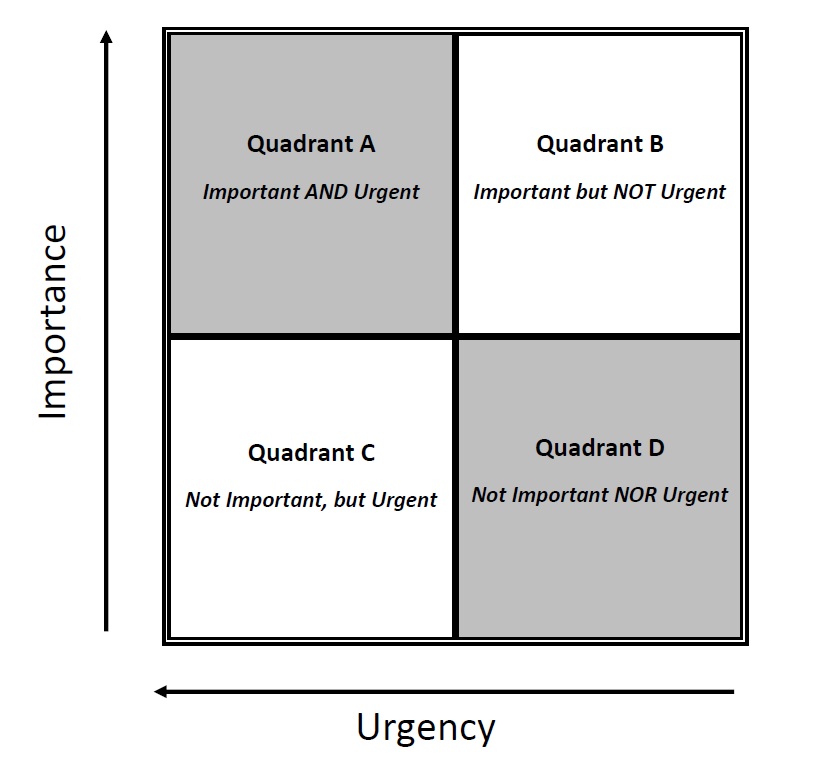
There is a time management tool called the Time Matrix. It is divided into four quadrants, where how your time is used is identified by two criteria, Importance and Urgency. It looks like this.

I’ll not insult you by explaining it, although that can be done by reading my book Police Time Management, but as you can see, tasks in each quadrant are identified as (for example) Urgent AND Important, Urgent NOT Important, Important NOT Urgent, and neither.

Now consider your spending habits. What have you bought, recently? Where did that purchase sit? I recognise there are some value judgements to be made, here, but I would respectfully argue that some of the aforementioned purchases (e.g. a new or leased car as opposed to cheaper, paid for older model; tattoos; the latest iPhone; Starbucks other-expensive-luxury-coffee-brands-are-available drinks; nights on the lash) RARELY EVER hit the top half of the Matrix.

If you are struggling, you really have to decide for yourself where economies can be made – and your ego and feeling that self-worth is dictated by what other people think of your car/address/body art/coffee choice should be utterly ignored when making those decisions. Leasing a new car is great, except at the end of the lease period you don’t own a car that is an asset you can sell. Duh!

Until I retired and got my lump sum the average age of my car, by choice AND imposition, was 10-15 years. I got bank loans to pay for a 2k and (even) an £800 purchase of cars, when one car was all we could afford. When we needed two, they were also old. Even now, my mum’s estate paid for my (then) 5-year-old sports estate which I will run until it dies. (Which may be a while as it’s still only done 60,000 miles.) Of course, if I win a lottery, I may go nuts. But not until then. And I never left the UK between 1985 and 2015.

How about a mortgage? If you’re renting, find a house that the same monthly amount will buy (but wait until interest rates shrink). Read and listen to Martin Lewis moneysavingexpert.com stuff. But above all, don’t moan about the cost of living when you’re sitting on something that really was purchased from Quadrant D.

I’m sorry if these suggestions hurt your feelings. You earn money to spend it as you want, in a perfect world. But the facts don’t care about your feelings, and you know in your heart that blunt as I am, what I’ve suggested is common sense.

Think hard. It may not solve your problems in a week, but a new approach to spending will make life a little bit easier over time.

Don’t Pull Your Own Trigger

(Bit of an add-on to my last blog, but important, anyway.)

It’s the week after Mental Health Awareness Week, which is the UK’s week-long answer to the American Mental Health Awareness Month – maybe a reflection of our shorter attention span or their inability to understand things quickly, who knows?

 During this period I have been inundated with posts on various social media where people have disclosed their struggles with mental health, and I have to admit to being torn. On the one hand, they are struggling. On the other hand, they seem to be saying ‘Look at me, I’ve got it bad’, as if having mental health (stress) challenges is a competitive sport and they’re winning, or at the very least they have got your attention for a minute or more.

Yes, I KNOW that seems unfeeling. But here’s the thing.

If you are genuinely suffering TALK TO SOMEONE. But Twitter isn’t someone. Twitter is a place to get attention.

(Incidentally, if a Twitter ‘friend’ discloses mental pressures, perhaps you should make sure that they WANT you to retweet to complete strangers. Moving on.)

Then I read a tweet from someone who disclosed that a third party had ‘triggered’ her, knowing that he was ‘triggering’ her, and there was, naturally, some sympathy expressed for her situation.

But I have read the 7 Habits of Highly Effective People, and here’s Stephen Covey’s take on ‘being triggered’:

“It’s not what happens to us, but our response to what happens to us that hurts us. Of course, things can hurt us physically or economically and can cause sorrow. But our character, our basic identity, does not have to be hurt at all. In fact, our most difficult experiences become the crucibles that forge our character and develop the internal powers, the freedom to handle difficult circumstances in the future and to inspire others to do so as well.”

Covey, Stephen R.. The 7 Habits of Highly Effective People: Powerful Lessons in Personal Change (p. 95). RosettaBooks. Kindle Edition.”

I cannot know the poster’s situation. And I did not comment on the tweet, nor would I expect such counsel as this to be welcome. And I certainly don’t find it easy to act upon it, myself. But my own awareness of the idea that I can CHOOSE not to be ‘triggered’ does, occasionally, result in a better response than choosing to be miserable. And this is the advice I would like to offer to the offended (and to the easily offended, but that’s an argument you can’t win with those who are too busy being offended on behalf of those who aren’t offended by what SJWs are offended by).

  1. Choose not to be offended.
  2. Challenge those who are trying to offend you.
  3. Give them one chance to apologise.
  4. If they don’t, escalate it to someone, because these days there is someone to whom it can be escalated.

BUT FIRST, give them the chance to apologise because believe it or not, some people don’t realise they’re being offensive, in part because the rules on being offended have changed since COVID.

I gave a speech a while ago, and I bemoaned the fact that modern police organisations spend more time on diversity training than on criminal investigation training. Two people in the audience took offence. One, a diversity trainer, decided I was attacking diversity – I wasn’t, I was attacking my perception of an over-focus on it – and was really (excuse me) triggered. Her argument was made quite aggressively. She chose to be angry.

The other, a trans woman, was measured, and listened to what I was saying (which included an apology if my words hadn’t accurately expressed my intended meaning). I suggested that most people are good people and didn’t need extensive ‘be nice’ training. She was patient and just said, “Some people need to be taught how to be nice.”

And THAT was the more powerful argument. Made politely, gently, and all in one extremely profound sentence.

Two people, same trigger. Two different responses. And the patient, considered response won my heart.

So don’t ‘be triggered’. Choose your response and feel better for it.

And no, I don’t need to read about it on Twitter.

For more on ‘policing your own stress’ through better self-management, read ‘Police Time Management’ by David Palmer, Retired Fraud Squad and Divisional CID Detective, available HERE on Amazon.

Question Your Attitude Towards ‘Time Management’.

Attitudes to Time Management vary.

When I use this title, I am not referring to how people ‘see’ time management as a method, or technique, or as a great big pile of ‘new stuff to learn’.

No, what I intend to address here is more about people’s attitude towards whether or not they actually want to manage their time. I am going to analyse why it is people either don’t think they need to manage their time, or why they think that their time can’t be managed. The truth is, everyone needs to manage their time better, but many just don’t want to be told that. The suggestion that they need instruction in time management openly implies that they possess an inability to do what in their minds ‘should come naturally’ and they don’t like that. They are happy to be trained in their job, how to cook, or how to drive a car, but to many people time management is seen as an innate skill, even an instinct, and “I won’t / don’t need to be told how to do that!”

Your ability – or inability – to manage your time is affected by a plethora of circumstances, but if we were to identify specific situations where people find time management challenging, we would discover that they all come under one or more of five headings.

  1. Some situations are outside your control and you accept that, but in that acceptance they accidentally conclude that the inability to control some some circumstances goes on to apply to every circumstance;
  2. Some are controllable, but you simply won’t try because you think they can’t be controlled – in parallel with 1 above;
  3. Some aren’t controllable, but you mistakenly try, anyway, leading you to conclude that nothing can be controlled;
  4. Some are within your ability to control them, and you know it, but nevertheless you don’t even try;
  5. But most of all you love the ones you think you can control, and you are controlling them – but it doesn’t occur to you to control the things you don’t like.

Heavy, I know.

The objective of my book ‘Police Time Management’ is to increase the number you can and do control (bring 2 and 4 under 5); to manage your attitude and response to the ones you can’t (improve your understanding of 1 and 3); and to stop wasting your time trying to control the impossible.

AND THIS IS IMPOTRTANT!

All of the advice in that book applies just as much to your personal life as it does your working life.

I encourage you to think about that, deeply. I firmly believe what you would learn by reading that book to everything in your life. There are two reasons for this.

First of all, we don’t live compartmental lives any more thanks to the smartphone, but we nevertheless still insist on thinking that we do. But the main reason I think it applies across the work/personal divide is because of the choices we make.

We choose our work – we apply for a job, fill out the form, complete silly answers to odd questions, maybe do a presentation, certainly undergo the ordeal of an interview, and then we get it. And then the job changes, things happen we didn’t expect, systems change, people change, laws change, the work gets harder and more prolific, we aren’t retrained and we get fed up with what we used to love.

But we also choose our lives, to an extent. Our ‘old’ family is set for us, but our friends, life-partners and our social lives are essentially a matter of choice (or not choosing but just accepting). Stephen Covey, author of The 7 Habits of Highly Effective People (1989) hit the nail on the head when he suggested that life isn’t about ‘whats’ and ‘whys’ and ‘hows’ – it is about relationships. Or to put it my way, everything we do – and I mean everything – we do for someone, with someone or through someone.  A lot of the time, we do all three things – we do something for, with and through other people all at the same time.

Everything in our lives – what we do, how we get what we have, how we behave – can have time management principles applied to it if we want to be at our most effective. And as personal time management can be affected by many criteria, it means our whole lives are affected by the same criteria.

What are those criteria, then?

  • Expectation – we have duties but we also make personal commitments which give rise to expectations in others, just as we expect others to do what we require of them.
  • Communication and miscommunication – how and what we communicate affects our ability to perform, just as it affects others’ ability to perform for us.
  • Interruptions (phone people) – the immediacy of the mobile phone has inadvertently enabled people to think it’s okay to interrupt other peoples’ conversations.
  • Priorities – we have priorities, those around us have priorities, and no-one thinks that everything being a priority means that nothing is a priority.
  • New systems, protocols and procedures – when you change a system, the training and changes to the old system have a time impact that is rarely taken into account.
  • Expanding responsibilities – the more you take on, imposed or elective, requires improved ability to manage everything.
  • Lack of practical training – a lot of what people need to know is now just ‘expected’. For example, is your ability use a computer now just assumed?
  • Lack of meaningful support – other peoples’ busy-ness means that they aren’t available to help as much as they used to be.
  • Values misalignment – what you think is important and requires passion, may not be approached in the same way by someone whose interests and focus lie elsewhere.
  • Unexpected responsibilities – surprise, you have a new role (no training, support, extra time or money available, sorry).

The challenge is not that these things shouldn’t happen. It is that they are facts of life. A lot of what we think is an annoying obstacle to our lovely and peaceful existence is, in fact, perfectly normal, and it is our response to it rather than the event itself that causes our stress. We think we can’t manage things, but the truth is, as indicated in the first paragraphs of this section, we choose not to manage things when we could, or we fail to learn how to manage things because we don’t want to or don’t know how to.

Proactivity and Time Management Methods are the answer. Or an effective part of it, anyway.

Find a good book about it, and apply what it suggests.

Stress Annoyance Month

Apparently, it’s Stress Awareness Month – which seems to last twelve. It’s an opportunity for people to pontificate about how wonderful they are at understanding stress when, in reality, they couldn’t give a hoot about that message in marketing and on social media posts when it isn’t that Month. And I have my own take on stress, born of my reading of some excellent works, and it is this.

Stress is self-inflicted.

Okay, that’s a blanket statement and there are a few qualifiers, but in this Twitter-led world of black-and-white, no-one’s interested in those qualifiers.

Stress is a mental and physical response to stimuli, and we have the ability to choose our response because we are intellectual beings with the ability to think about what we think about, so we can decide to think “Wow that bus nearly hit me! I could be DEAD!” or “Wow, that bus missed me! How lucky am I?” Most otherwise healthy people opt for the first response and start a downward spiral that would stop – if they just chose to take control.

Which is the primary benefit of the art that is called Time Management. Yes, managing the way you utilise your time has a great productivity benefit, but there is huge scientific opinion that being in control is the greatest vaccination against stress there could be. Of course, you can’t prevent nasty things happening, and no-one is pretending that making a positive choice is easy – but if you are clever enough to read, you’re clever enough to pause, consider, mull, and then decide that what happened or is happening will not control you – YOU will control your response to the event.

How do I know this is true? I know because not every war veteran gets PTSD, not every depressive commits suicide, some people thrive on being busy, and people can forgive some serious wrongs committed against them. The difference is not the event, it is the ability of the individual to deal, and they deal by taking charge. Some people’s ability to deal may well be compromised by any one of a number of good reasons, and they deserve sympathy, help, treatment where appropriate.

But if a man like Viktor Frankl can survive a concentration camp, and the experience of seeing his family killed by Nazis, you can cope with an excessive workload. And in that poor analogy, you cope by taking charge of the workload, by staring at it and thinking, “Poor Me.” That approach makes the problem bigger because inaction breeds work. The pile gets bigger if you leave it, not smaller.

(Although in my book Police Time Management I do mention an arguably unethical way I did reduce my workloads by inaction. Not sure I could do that, today. But it’s an interesting thought, surely?)

You want to suffer less stress?

Take charge.

End of.

How To Complete EVERYTHING in Two Minutes

Admit it. There are occasions when you have a task to do, and you spend more time and effort in avoiding it than you would have done in doing it. Everybody I know does it, even the most productive people of all. But those last examples don’t do it anywhere near as often as most of us.

Of course, you ‘ve all heard of procrastination, so I won’t insult you by defining it. That would waste time. (LOL) You already know the meaning of something you routinely do.

The most effective answer is to apply a rule outlined by Getting Things Done author and productivity expert, David Allen. His rule is – if it will only take 2 minutes, just do it now. One caveat – if you have a 5-minute task, then do that if you have five minutes. Basically, the time span of the rule is dictated by your personal circumstances.

“But the things I do will take longer than two minutes!” I hear you cry. I know you thought that because I thought it, too. But here, as Shakespeare would say, is the Rub.

Starting anything always takes less than two minutes. The decision to stop procrastinating and to start taking action is instantaneous. Let me illustrate by example.

If you’re like me, you have a hatred of taking routine statements from witnesses – particularly the routine drivel that the CPS memo has demanded from you. The one that’ll take an hour but has no evidential, procedural or practical value whatsoever, but because the lawyer has stretched a reason for wanting it, you’re stuck with having to take it. You procrastinate. You find excuses to put it off because of more urgent tasks. Then there are night shifts, court commitments, training days and other reasons, and before long that one hour statement has taken two weeks and you haven’t even put pen to paper.

But then you decide to apply the two-minute rule. First moment – decide to do it. Next – find the contact number and call the witness to arrange a time. That’s the job progressed a short way, and you haven’t even left your chair. You have also created an appointment, thus managing that period of time. You are now in control of the job. That is enough to make you feel better about what you have to do. When the time comes for the statement to be made, you assemble the necessary documentation (if you haven’t already organised your ‘stuff’ so there’s always a S9 form to hand), travel and start, and it’s done.

I’ve written before about how small, unfinished joblets like this mount up, and that is one cause of stress. But “I’m too busy” is a poor justification for procrastinating, if procrastination is the reason you’re busy. Work doesn’t go away: left undone, it builds up.

You want to be known as a productivity wizard? Apply the 2-Minute Rule to get progress on all of your tasks and the rest happens almost by magic. (Metaphor stretched, sorry.)

In my book, Police Time Management, I tell of how CID colleagues made a critical mistake in terms of putting work off because more important work came up, thus creating unnecessary personal stress. I always organised my time so that my own work never got put aside for something bigger. I just organised myself so that I could do both. And it wasn’t tiring or tiresome. In fact, it was easy.

It only took two minutes to plan.