Back with a Bang – or with a Bump?

I have just returned from a mid-week break and am feeling great. I spent a little while reviewing my personal values and made a few discoveries. But those are for another time. The main thrust of this blog is to address how we get back into work.

After a period of leave, how do you feel at the thought of going back?

Do you look forward to re-engaging with your projects and your colleagues – and customers? Are you excited at the thought of new challenges? Can you wait to find out what you’ve missed?

Or do you dread the emails, the memoranda, the buck-passes, the mess you left before you went away? (And some of the people?)

Notwithstanding the many issues that affect our attitude to work and the many factors that might cause us distress (as opposed to eustress, which is ‘good’), there is one element of a return to work that most people dislike, and that is having to catch up with the mess we left behind. A pile of outstanding incompletes, as author Jack Canfield would put it. And if you look at it objectively, a large portion of incompletes is – your own fault.

Many people, faced with a leave period or even a job change, do something that the stressed and disorganised tend to avoid.

They tidy up before they go. Not just the desk, but every incomplete that they can finalise before leaving. They spend the last tour of duty making sure that as many ‘I’s are dotted and ‘T’s are crossed as they can. They are able to put in a massive effort because they know that completed or managed work won’t bite them on the bum on their return.

Extremely well organised people, on the other hand, do not wait until the day before they go on holiday to organise their work in a huge, almost panicked effort. Oh no.

Extremely  well organised people pretty much carry out that level of personal task management at the end of every single day. Any minor matters that can be finalised before they go home for dinner is topped and tailed daily. They don’t have to worry about coming back to a pile of incompletes as big as yours. Their pile, if it exists at all, is teeny weeny. And the same goes when they come back from extended leave periods. They’re on top of things in no time at all because they were on top of things not only when they went – but all of the time. And it takes a lot less effort than the ‘last day panic’.

Time management may be a cliché these days, like ‘journey’ (Oh how I hate that word). But well executed personal management massively impacts your levels of stress. Paperwork creates stress (even though it won’t actually bite you – paper cuts aside) but managed paperwork creates a lot less if you keep on top of it as you go, not after you come back.

Learn how to manage yourself in the context of time. It’s the most valuable self-taught ‘thing’ you’ll ever learn.

#timemanagement #selfleadership #personalplanning #system #police #metpolice #policing #stress #book #professionalpolicing #merseysidepolice #gwentpolice #collegeofpolicing

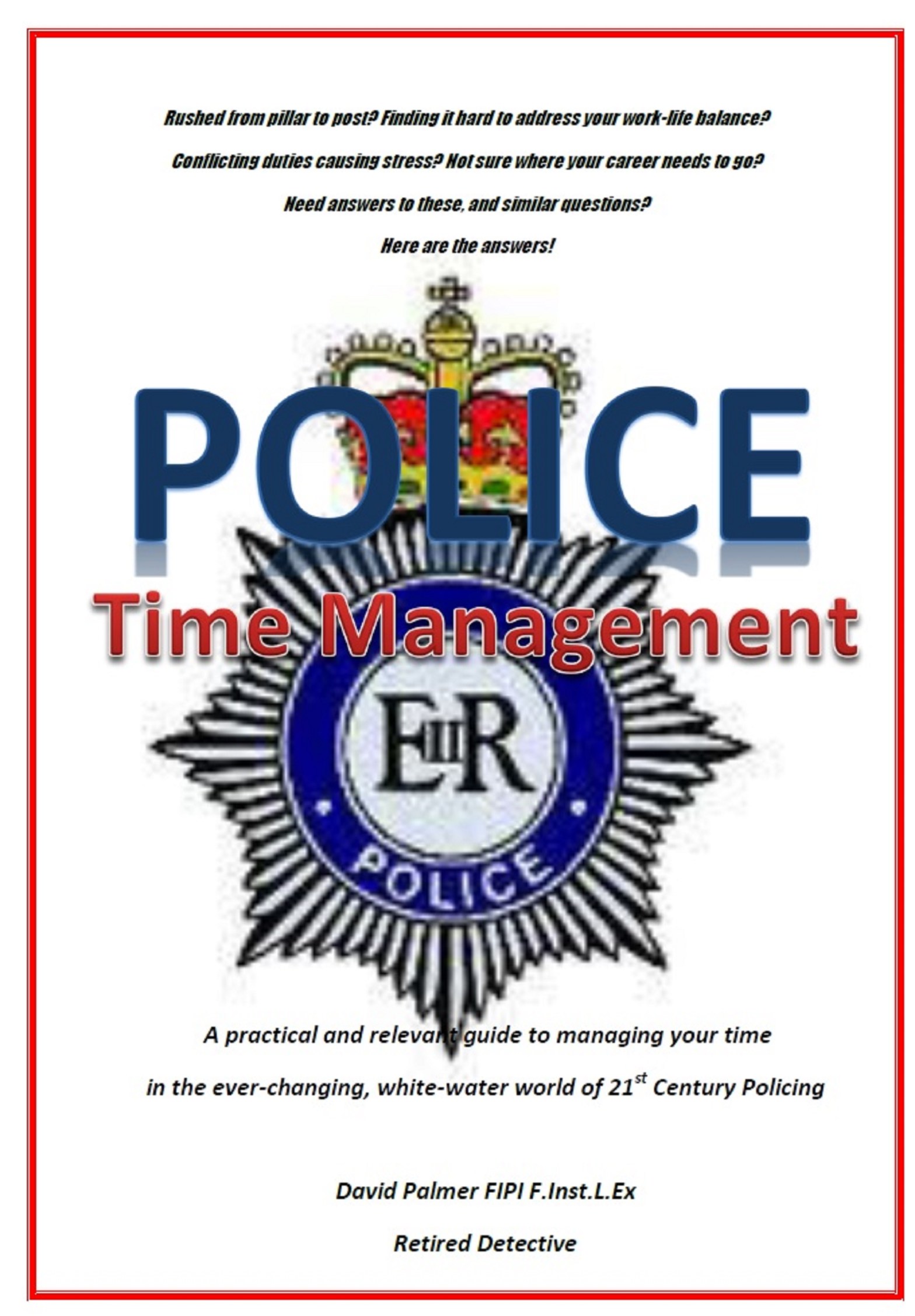
Policetimemanagement.com – The book is getting ready……
When it stops – it all starts.

I really feel for my police colleagues at the moment. They have been taken from the duties they expected to be executing – routine patrols, criminal investigations, domestic squabbles, crime prevention, community partnerships, etc. – to having to police protests committed by citizens with genuine grievances, and riots committed by chancers who wish to use public unrest as a means to commit further crime and rebel against what would normally be a well-ordered society.

I feel sorry not only because they are put in harm’s way simply by virtue of the need for what they are doing, but also because the post-riot period will be filled with the additional, perhaps less immediate but equally pervasive stress of having to return to normality, and still having to deal with all that stuff that was piled up on their desks before it all started.

Yes, it seems unimportant at the moment. I disagree, a little. It isn’t as URGENT, but it remains important unless and until a senior leader says, out loud, “Some of that stuff you have piled up – let it drop.” And I have never, ever heard a senior leader say that. I DID hear them say it before they were senior leaders, oddly enough.

There are two levels of stress I wish to address, here. The first would be comparable to post-traunatic stress, where the immediacy of danger and threat causes the stress that is equally immediate, inherently more visible, and usually well-managed by supervisors for that reason.

Then there is the drip-drip kind of stress, which builds up reaaallllllyyyy slowly, is not inherently visible, and is treated – if it is treated at all – when it’s already too late. It is the stress caused by the inability to do the little things which, although they are little, still have to be done because systems and protocols demand they be done.

Pretty much every copper I know has wanted to do a great job, but the obstructions to what they perceive to be part of that ‘good job’ – paperwork, unwanted training days, abstractions which they see as not serving their situation, delays in complaint handling, incessant interruptions – are the things that cause stress.

When your head goes, the cause isn’t that relevant. Whether it is trauma or drip-drip, suddenly you lose your edge or your temper. The first results in failed prosecutions and competency questions, the second in having to defend your career.

This is why I am trying to teach colleagues better time management method. Firstly because no-one else is teaching it effectively, and secondly because I know that having control over what is happening is an absolute MUST if stress is to be minimised.

When these times settle down and we go back to the daily grind of routine, there will be a pile of tasks to manage. The To Do List won’t cut it.

Particularly if some special interest group decides it’s been offended by something they’ve heard from a biased source, but which they accept without question because it suits their interest to do so.

At which point the pile of paper gets left on the desk again, and the circle continues.

So yes, time management may seem unimportant in the moment. But after that moment, it becomes an absolute necessity.

Police Time Management – Paper or Digital Planning?

Hyrum Smith, time management authority and seller of thousands of Palm Pilots, was asked in 2009 about technology and planning. This is what was said.

Q; Technology today offers many electronic options for managing time, but I still love my paper planner. Are we seeing a return to paper and pencil, or is the trend going toward electronic tools?

“My impression is that there is a surge returning to paper. I will never forget when 3Com brought in and put on my desk the first Palm Pilot. I played with it and thought it was a great toy, but no one will ever buy one. I turned out to be wrong about that. We strongly embraced technology at our company and sold 10,000 Palm Pilots a week for several years, and then all of a sudden, we didn’t. People stopped buying PDAs. I thought, “I’ve got to try the Palm Pilot.”

I put away my paper planner for 13 months. I went to a PDA and I discovered that I could do everything in my Palm Pilot that I could do in my paper planner, but I wouldn’t. The reason I wouldn’t is because it took too much time. It was too hard to do. I came back to my paper planner because of the ease of the operation. What I discovered was that for managing tasks, appointments, and taking notes, a paper planner is four times faster than any electronic device. There is a whole host of reasons for that, but I will just leave it at that level. A paper planner for tasks, appointments— managing me—is four times faster.

Now, there is a place for technology. I carry a BlackBerry. I love my BlackBerry. What do I use it for? I can communicate my calendar to my people. I can download The Wall Street Journal. I can check my email. It is a wonderful phone. But for managing me in the heat of the day, my paper planner is more effective and it is faster. I have had letters from CEOs, senior vice-presidents from all over the country, telling me, “Hyrum, I’m back to my paper planner. I’ve got control back in my life.” In fact, just a year ago, a senior VP from Merrill Lynch went through our seminar. She said, “Hyrum, you trained me 18 years ago, I went to an electronic device 3 years ago, I lost control of my life. I went back to my paper planner and my control is back.” There is something about writing on paper that a human being likes.

The thing about those three things: tasks, appointments, and taking notes, and if I know how to retrieve those notes—the magic of the Franklin Planner is the retrieval system. The minute I write a note in my planner, I’ve given that note a root in time. I will always be able to find it. There are three different ways for retrieving information from a Franklin Planner. I can do it with lightning speed. If you don’t understand the mechanics of the Franklin Planner, you don’t understand why people would use that instead of technology. If you’ve gone through the class and you’ve been taught well how to use it, it is a dangerous tool. I’m a paper guy myself.”

I’ve spent a few hours pondering about using my smartphone for planning, but I can’t get around the size of the keyboard, the fiddliness of the note-taking facilities, the constant spell checking by me or machine, the fact that the phone will be gone at the end of a contract along with all that I record on it (no, you never really take the time to transfer it all), and the poor way the diary/task management software works in reality. Not to mention the fact that for all that tech provides, all smartphone users are still carrying around heaps of paper anyway.

And you and I both rely heavily on To-Do Lists, do we not. And I’ve not seen a smartphone that does a To Do List as well as a bit of paper.

If the leadership of companies like Merrill Lynch think paper is best, who am I to argue?

For daily updates on police time management, go to @PoliceTimeMana1 on Twitter.

It’s 2020. Time for change.

I wrote and published the original text for Police Time Management in 2010/2011, and a lot has changed since then. Looking at the content I decided that a complete review was necessary, and as such I am now fully engaged in that work. Chapters rewritten and re-ordered for maximum practical effect for the readership: extensive levels of new thinking on the theories behind the practices: lots of research to add content and redrafting the forms that will be in the book, and then available on-line.

I have set an end-of-year deadline but I am so passionate about my former colleagues’ personal effectiveness and yes, their happiness, that I intend to spend a LOT of my time on this project. I’d love you to get a copy for Christmas!

In order to do that I also have to learn as I write. Stephen R. Covey, author of The Seven Habits of Highly Effective People, used to speak of Third-Person Teaching. This occurred where each of his students would be required not only to learn what he taught – but to teach it to others. He expressed the opinion that having to teach what you learned sharpened the senses, reinforced the learning and made you an advocate for ‘your’ version of what you learned.

As such I am also deeply immersed in learning about the relatively new digital approach to self-management. What I learn I will pass on.

I believe policing to be the most stressful and yet rewarding of careers. It constantly (!) changes but the principles and methods I intend to impart will enable policing professionals – officers AND staff – to better cope with whatever is thrown at them.

Watch and wait- I intend that what develops will help you all.